Wednesday, July 27, 2016

Big Differences with My Life in the US


Now that I have been back in the US for close to a month, I want to reflect on some big differences between the life in the US and life in PNG.  Here in the US...

1)  I am part of the majority not minority ethnic group.  In PNG I really stood out as a white person, here in Wisconsin most everyone else is white.  There is certainly more anonymity which can be a relief, but I miss some of the white privilege that went with it.

2) I am middle aged, not elderly.  The lower life expectancy in PNG makes quite a difference.

3) I am middle class, not rich. I was glad to have enough money to help the students, but I learned what a responsibility it is.  It has been rare in my past life for people to bother to try to swindle me, a different story in PNG.

4) I am surrounded by consumerism.  There was a refreshing lack of advertising in my daily life at Logaweng.  Without TV, radio, or newspapers, internet was the only way I was bombarded with ads.

5) I see lots of cars and few pedestrians.  When the whole campus has only two vehicles you do adapt.  It seems strange to be in the downtown area and see so few people on the streets.

I have been visiting family and now am getting serious in job hunting. I am looking for a parish position.  This will be my first since graduating.  Prayers would be appreciated.


Wednesday, July 13, 2016

farewell pictures

 
Relaxing in my yard with year two students and their families after our farewell meal and speeches. Students (l to r) in back row are Joshua, Dea, Jeremiah, Israel  Front row L - R Jeggy, Mathew, Siamon, Aisac.


Looking at some of my pictures from the US.  Since their are few sources of media (such as TV, magazines etc.) around the pictures are of great interest.  Generally the women sit on one side of the room and the men on the other.  If their are a lack of chairs the women will sit on the floor.

Decorations for my farewell party with the whole seminary.  The sign says God will be with you Pastor Ann.  All the plants and flowers come from on campus.

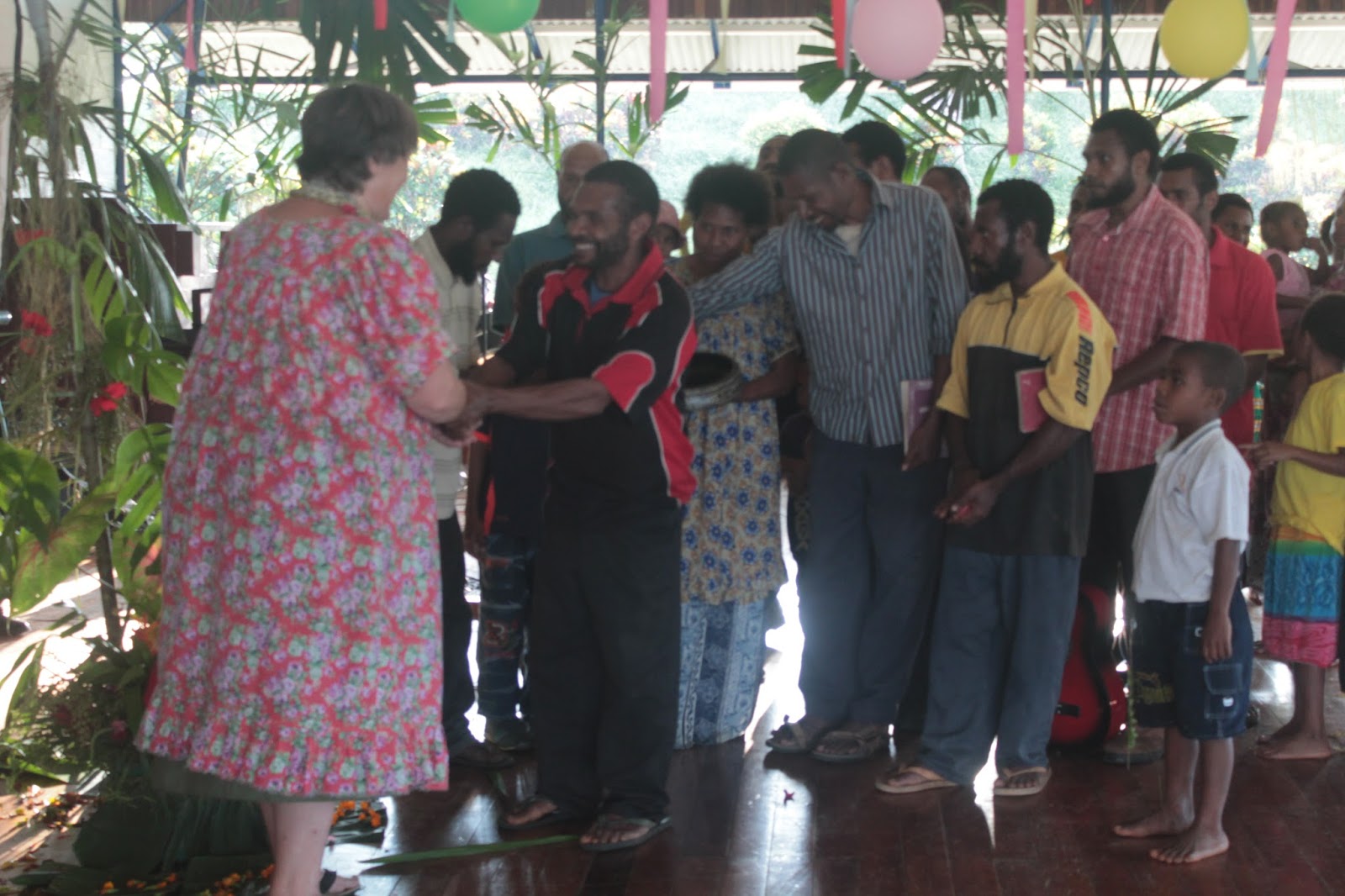
Shaking hands with year three students and their families.  In honor of my being an English teacher they sand English hymns for me (maroon songbooks). 


Tuesday, July 12, 2016

saying farewells

As I have been gone from Papua New Guinea for over a week now, I want to reflect on the process of saying farewell.  It has been both difficult and heart warming.  I have been thinking of some of the reasons that farewells are done so elaborately in Papua New 'Guinea.

1.  Travel is difficult and expensive.  It is true that we will likely not see each other again.  Here in the US it is usually easy to go back and visit, not so in PNG.  I see this every year with the tears shed by the senior class at graduation time, they have been in classes together for 5 years and may never see each other again. 

2.  Mail is irregular, phones are expensive and internet may not be available.  It will be hard for us to keep in touch.  As smart phones are becoming more common and mobile phone coverage  I have started seeing some students and faculty on Facebook.

3.  People are used to living in villages where there is slow turnover of people.  They are used to the idea that they will be in relationship their whole life.

I had three farewells, one a dinner with my waspapa or advisory group, a potluck with speeches with the Year Two Class, and a campus-wide farewell.  This included a meal, entertainment and gifts by each class and the dedication of the new campus kitchen.

These farewells were wonderful and made me realize how deeply involved I had become with the community.


Thursday, June 16, 2016

The final week at Senior Flierl Seminary

     I find it hard to believe, but I am in my last week at Senior Flierl Seminary.  I leave exactly one week from today. I am taking this week off teaching to try to finish things up.  Being a disorganized person this is hard.
 
    I have sorted most of  house, some of which I had never sorted when I moved in.  These houses come with a lot of things (cargo as it is called here).  This is nice as it means you do not have to bring a lot of things with you.  My board encouraged me to bring only the suitcase allowance brought on the airline. However, every time I have gone home I have brought extra back with me. Fortunately most of these were books, which I am leaving behind.  I have already had a book sale and am donating the rest to the library.  People have bought a few of my items, such as my ice chests (for bringing frozen food from Lae) and spare bag or suitcases.  People have inquired after my solar lamps, computer and telephone.  However, I am not selling them.  I am giving the lamps as gifts and taking the phone and computer back with me.

    One task which I have finished is handing over the bookstore.  I had been running it rather informally, so have had to get things organized. I am proud of the work I have done there, helping the students get books they will need through out their careers.  Books are so hard to get in PNG!  I am very happy that Elvie Huevos, from the Philippines is taking over from me.

    An area that I am focusing on now is getting the library cleaned up.  We started an inventory back in January that still needs to be finalized.  I also have donated many books which need to be cataloged and put on the shelves.  Again, Elvie Huevos is taking over until they find another person.  I am relying on her to work on finishing up the backlog.

    Another thing I have let go is being the English teacher.  Being the only native English speaker I have been the "expert".  Fortunately one of the new teachers has experience teaching English.  I have turned over my books and files to him.  I have also given him the copies of "The Lutheran" (both US and Australian issues) which I had let the students use for outside reading.

   My next blog will be about saying "Farewell" in PNG.  It is not something that is done lightly here.


Friday, April 15, 2016

I can see clerly now

Wanted to share the news that my cataract surgery went very well back in February.  I now need glasses only for reading.  My distance vision is clearer than it has been for years. Since cataract surgery is not common in PNG people are quite impressed.  One faculty member mentioned that I am like Bartemeus (healed in the Gospel of Mark).  He was joking, but it does show how it all impressed him.

Being in Brisbane AUS for three weeks (including some dental work) highlighted for me again the difference between a first world and third world country.  I did appreciate having reliable transportation (great bus system), consistent electricity and thus running water.  I also appreciated the variety of food and restaurants available.  I think about all the troubles of daily life that people here in PNG have to put up with. It can be frustrating to watch. I wish I could wave a magic wand and eliminate corruption and all the other issues here. However, I am thankful that God has lead me here to do what I can.  We always have to trust that God is control of things, not us.

It was also interesting to be in a majority white culture again.  In PNG I literally stand out from the crowd.  It is sometimes uncomfortable, but can also bring privileges.  For example my bags are never checked by the security guards at the doors in stores.  This was a good reminder of some of the changes I will experience when I am back in the U.S.  

Thursday, April 14, 2016


My kitty Fiona (adopted from the Thumser family)

on campus children at Christmas

2016 school year

Well, we have finished the first term of the 2016 school year.  We are in the midst of a one week break and then will have another 10 week term and then semester break.

There are fewer students on campus this year.  The new first year class has only 10 students in it, while the class out on vicarage (internship) has 21 students in it.  However, this has not meant fewer children on campus.  The first year students have to leave their families at home, The year two class, who brought their families to campus this term, has lots of children.  It is not especially large class, 19 students, but has few single men and families with up to 5 children.  Considering how small the houses are, some people must be sleeping wall to wall.

This tradition of  the men coming alone for the first year may be changed.  It is supposed to have the advantage of giving the men more time to focus on schoolwork.  The families were able to stay with his family (most often) who would look after them.  However, times are changing and this is more difficult for some families.  Also, the drought in the highlands last year meant that many families were living in an area that had shortages of food.  This was then quite a worry for the men who were here and couldn't afford to go home and help.  The second reason for the men coming alone is a shortage of family houses versus dorm space.  However, we need to look at what is best for the families.

Another big change coming up is a change in curriculum.  The national curriculum passed at the National Synod said that we would have to switch to English only - perhaps as early as next year.  It is still playing out as to how quickly the change will really come.  Since I am leaving at the end of this term I am not part of the discussion.  It is hard sometimes to step aside on issues I feel strongly about, but the solution has to come from those who are staying.  Fortunately our new faculty members have good English, one having taught at the English language seminary.

The next term will be busy.  I am glad I have only 5 credits to teach.  There are a lot of things I still need to clean up in the library as well as train my replacement.  There are a lot of things I know, but have not written down.  I also need to hand over te bookstore.  Fortunately that is better documented.

Okay, time to sign out and makes my class outline for the coming term.

Thursday, February 25, 2016

ch-ch-changes , not renewing my contract

Time to share the big change I am making.  In July my contract will be over and I will be coming back to the United States.  I decided not to renew as it seems time to come back to the US and look for a job in a congregation.  It was a tough decision as I have really enjoyed the work in PNG and have found it very rewarding.  However, after my father died I realized I felt the need to be closer to my family.  I also have been fighting nagging health issues that are more easily dealt with in the US.

I have had very mixed feeling and prayed a lot about it.  In many ways these last three and a half years have been both the most rewarding and the most difficult time in my life.  I have enjoyed the students very much and will miss working with them.  It is a rare privilege for someone with a MDiv to get to teach in a seminary.

I do plan to continue to give at least short bursts of sharing on this site.

Tuesday, February 16, 2016

Christmas in PNG

In my previous post I mentioned that Christmas is low key in PNG.  I got a few questions about it, so here are some more thoughts.

Reasons that Christmas is more low key.
1) Christams is seen as a religious holiday, not a cultural event.  Easter is just a big of an event or perhaps bigger.  Both may include a Bible Camp.  The equivalent of a synod will get together and have three days of Bible Study together.  A guest preacher (such as SFS faculty members) comes and gives around 6 hours of Bible study/ talks over a three day period.  There will be singing and dancing involved, but that is part of every church gathering, not especially tied to Christmas or Easter.

2)  Cultural history is tied to other events.  Christianity is quite new in PNG - 50 to 100 years in most areas.  This means community customs and celebrations have been tied to other events.  For many of us in America, Christmas has ties to our family history and may show marks of the "old country" our family came from.  In PNG your home town or "as ples" is your "old country".  So, even if you have moved off to the city to work, you are likely back home in your village for Christmas.

3)  Less distinct seasons.  Here in the tropics you have rainy season or dry season, but the timing of this  varies from location to location.  So, there is not the distinct visuals of North America and Europe.  Christmas is not tied to snow or even cooler weather.  Easter is not tied to Spring.  This not only affects the visuals but also the food available.  The main parts of your feast meal, such as pig and potatoes, will be the same whenever you feast.  Though one time you might have pineapple and another time you may have papaya. However, I don't hear talk of particular Christmas food.

4)  Lack of cash.  Many of our traditions, such as special Christmas decorations require some cash.  When you are a subsistence farmer, you decorate with flowers etc. year round.  Again, less special signs of Christmas.  I have heard that the Christmas pageant may be quite elaborately decorated, such a stable built and some sort of lights to stand in for the star.  The star is supposed to move across set to help guide the wise men.

5) life of a farmer.  Most people in PNg grow their own crops.  So, while you may take a few days off, you have to keep on working to have food ready.  Even our students that go home do a lot of work in their parents' garden or farm. Farming is year round here, with crops being planted and harvested on a regular basis.

In Lae, the bigger city in my area, I did some some decorations.  The stores would have a few strings of lights up.  I saw a few plastic Christmas tress.  It is a quiet time for many of the churches in the city, as many people travel to their home town for Christmas.

Sunday, February 14, 2016

End of the old year

I have been lax in writing, so thought I would do some quick catch up on the end of 2015.

I spent the first half of December on vacation in Brisbane AUS.  I stayed in small apartment and enjoyed the city life.  I did shopping and did a lot of doctor/ dental appointments.  OK, I didn't really enjoy the medical / dental work, but was glad to get it done.  I was relieved that I got a bridge and no longer have a gap near the front of my mouth from where I had a tooth pulled around the time of my Dad's funeral.  Gaps are common in PNG, but I felt self-conscious about it.  I also got to the bottom of my vision problems.  My vision had been getting blurrier.  I had thought about waiting until I was in the US for treatment but it was bothering me too much.  I found out it was garden variety cataracts so scheduled surgery in Brisbane in February.

I spent the second half of December relaxing back home at Logaweng.  Most of the students go home, so it is very quiet on campus.  Christmas Eve we had a campus wide worship and party.  On Christmas Day a few of us went swimming and had a picnic on the beach.  Pleasant and SO different from the elaborate Christmases I grew up with. .Christmas tends to be low key in PNG. At first I missed all the decorations and bustle around Christmas, but have learned to appreciate the peace also.

I gave a sermon during the New Years Eve worship (in Tok Pisin so lots of work for me) and then we welcomed in the New Year by burning all the church decorations from Christmas.  Since the decorations are all fresh flowers and branches, they are dry by New Years.  Bon fires are a lot of fun!.  There was extra flames this year as our former principal, who will be moving,  burned his "haus win".  These are  detached from the houses and sort of like covered porches that many families use to relax and enjoy the breeze.  They have wood floors and walls about waist high.They often eat there and mainly go inside to go to bed.  Each family usually builds their own out of "bush materials" which includes local logs, branches and reeds.  After about 10 years they fall apart and you build a new one.  Traditionally a man did not get married until he knew how to build his own house.  Houses are provided for staff on campus but they are very small.  Most have extensive benches and haus win areas.. They also grow almost all their own food.  Quite a different set of skills than most American faculty have!
  

Thursday, November 26, 2015

Graduation Preparations

Well, we have come to the end of another school year.  Graduation wil be this Sunday.  The classes have been over for a week and lots of prepartaion is going on.

Some of the highlights:

1) approval for graduation and "going vica".  At the end of the year the faculty makes final approval of students to graduate and those that will go out on their Vicarage (Internship).  We were relieved that all theYia 5 students (Seniors) passed their final test and were approved.  Some years it has been a close call, but not this year.  However, only one completed the extra research paper to get the Diploma of Theology (rather than the Certificate the others get).  There were more problems with students wanting to go out on vicarage.  All were doing fine academically, but there were behavioral issues.  Three were not approved, though all were given the chance to return at a later time.  They are sent back to their home districts and can return when the leaders of the district say the behavior has been corrected.  Some of the issues are things we would ignore in the US (like having too many overnight guests in your house without permission) but others (like infidelity) would be a problem both places.  I had been the advisor of Dickson, who had been put on probation due to his lack of speaking and preaching  skills.  Fortunatley his hard work payed off and he was approved.

2) Physical labor - in getting the campus ready all the students put in a lot of physical labor.  The guys spent up to 5 hours on Monday walking up and down the road cutting the grass on the side with their bush knife (like a machete).  Most Americans would have wilted after half an hour or so.  The women did a lot of weeding, raking and wall washing.  Since it is the hot season work starts at 5:30 a.m.  Morning devotions are held in the evening.

3) Family arrival - the family members of the graduating students have started arriving.  They stay with the students (motels etc are not availabe or affordable).  Since the houses are very small, some of the students have built bamboo shelter for family members to stay in. They also have been growing extra food in their gardens and collecting extra firewood.  We pray the electricity stays good because that is neccesary for a water system to work.

4) Buying gifts at the Bookstore - This is a busy time for the little on campus bookstore that I run.  Some finaly members buy as a gift some expensive book the student has wanted (such as a study Bible).  Others have come from isolated areas so like buying Bibles, hymnals, church calendars etc. while they can.

OK< back to work.  Hope you all are having a good Thanksgiving Day in the US. 

Friday, October 23, 2015

Return of sunshine.


Letus showing off his new walking abilities


Students giving a welcome singsing

      After months of rain, we were all relieved when the sunshine returned on Tuesday.  The rainy season seems finally to be gone.  It is usually over by the end of September so people were getting concerned. It was a bit like being on Noah's ark after 39 days Now the food will grow faster and other work, like cutting the new gardens, can be done. Ground is used on a rotating basis, so a new garden is started for food for next year  The students that are leaving plant a garden so the new or returning students will have something to eat when they arrive.
     Ironically, other parts of PNG have been having a drought  One of the other schools, Amron Evangelist Training Center had to send their students home.  Not only did they have no crops growing, they were having to buy water to drink.  Fortunately it has started raining again in some parts of the Highlands. 


Thursday, October 15, 2015

Some surprising questions of daily life

I have been thinking about some fo the different ways life works here in PNG, so I have tried to group some thoughts together.

How do you say toenail in Tok Pisin?


       PNG is a country with hundereds of different langauges.  Tok Pisin is a language that developed between early colonialists and their workers.  Over time it has developed into a language that many different groups use to talk to each other.  Most of my students had their early schooling in Tok Pisin.  Then in the upper grades they start learning English. Since very few peole use Tok Pisin as a first language, it has asmall vocabulary.  There isn't a large vocabulary, so often people end up using a phrase for what would be one word in English.  So, a toenail is the cover of the finger of the leg.  A fingernail is the cover of the finger.  It is not suprsing that English words end up being substituted.  The Pigin word for Easter, is Ista, which makes sense. phonetically. However, the Pigin phrase for Passover is the equivalent of Day All Jews Celebrate Leaving Egypt. I use the word Passover instead!  I have been told that it is very hard to do legal work in Pigin since words are not very precise.  Advanced study, such as law and medicine, is done in English.  Our theological discussions generally are in Pigin with English words thrown in as neccesary.

How many Bibles do you want to buy? - Numeracy

    I came here aware of literacy issues (being able to read and write), but have become more aware of numeracy (being able to use numbers). Our students vary in their ability to do math, but all are able to do simple addition, subtraction, multiplication and division (though we have a review a the start of the frist year),  However, many of the people in the villages have a very limited knowledge of numbers, largely due to a lack of schooling I believe.  This is accentuated by the fact that some languages don't have a complete set of number words (e.g. 1,2,3,4,5,many).
     I notice it mostly in the book store.  Sometimes people from neighboring villages come to buy
Bibles and hymnals and have a very limited idea as to how many they can buy for the money they have. I have learned that when people are buying things, to tell them how mach money they have left, not how much they have spent.  To tell them that the two bibles come to a total of 39 Kina may not tell them much.  However, if I say you have two bible for 39 Kina, so you have 11 Kina left, then they can judge if they have enough to buy something else.  Originally I was giving them their change and they would then count the money and decide if they could buy anthing else.
     My friend Demaris, who is a doctor at the local hospital, gets some intersting answers to the number questions she asks.  Many people don't know their exact birthdate, but she is surprised at the age people think they are.  She has decided that 50 is a number that many people know, so they may say that if they don't know their age.   She was originally more surprised at the difficulty peole had in aswering the question "How many children do you have?" She has decided that some just think of the individuals and don't bother to put numbers to them.  Also, it may be hard to know which children to count.  Do you count the babies that died?  Do you count the two boys you took in when your husband's brother died?  Do you count the baby you gave to your sister when she was not able to have children?  She has learned to be more specific as to what she wants, such as "how many babies have you given birth to?
   I sometimes think of my seminary classmates from PNG.  I wonder what they were writing home about.?  What crazy things do Americans do?


Monday, September 14, 2015

Term 3 em pinis (is finished)

Well, I have finished term 3 and made it to the term break.  Our semesters are divided into two terms, so the second semester (mid July to early November) consists of term 3 and 4.  Usually we have only one week between terms, but this time we have two (hooray!). This is because two big meetings have come up and there would not be enough teachers for the classes.  If school is on the students are expected to come sit in their classroom whether there is class or not.  So it is a real waste of their time if the faculty aren’t around.  We international teachers are going to the German/ English Missionary retreat and 4 of the locals are going to the National Pastor’s Conference which is nearby.  I do think it will be a valuable experience for us teachers.  However, it will be challenging to get all the topics covered with one less week of teaching.

I am very glad to have the extra week as I am WAY behind in my work.  This includes both correcting papers and making lesson plans.  This semester is the heaviest teaching load I have had and I had bronchistis for over a month.  I am finally back to normal energy levels.

 I am still enjoying my new class – Kain Kain Bilip- or what we would call World Religions in the US.  I have really enjoyed introducing my students to Judaism, Islam, Hinduism and Buddhism (Daoism and Confucianism to follow). Now I want to go worship in these other traditions.  I have only been to two synagouges, never to a mosque or Hindu temple.

My other classes are Church History pt. 1 (through the Nicean Creed), English 2, 4, and 5.  I will be honest, I am starting to get tired of teaching English the way I have been.  Next year I want to develop some more units that will be on interesting topics and nore hands one.  I have made some progress in incorporating more theology into my teaching, such as reading about the beatitudes and increasing giving in churches. Now to incorporate more hands-on activites.

In the good news, my ability to speak Tok Pisin has continued to improve. The bad news is that I am called on to preach more.  While it is good for me to get preaching experience, it is SO time consuming to have to write in Pigin.  A wonderful thing did happen, I was asked to lead Holy Communion here at the seminary.  Communion is rare and strictly for ordained clergy,  With ordination being strictly for men here, some of the women pastors who come are never allowed to lead Communion.


Time to sign off.  I plan to go to bed early tonight, then get up tomorrow and correct the Sios Histori (church history) tests. 

Tuesday, August 25, 2015

Destrction of the Temple in 70 AD

   We are now in the 7th week of term 3.(our semesters are broken into two terms of 9 or 10 weeks),  I am enjoying my classes more than average this term.  It is a busy term, teachng 13 credits instead of the 9 credits of last year, (though I was still on home leave this time last year).  I have my usual three classes of English which I generally enjoy.  I am also teaching Church History, Pt. 1 again this year.   It is a good review for me to teach it again.  What I am enjoying the most is a class is world religions called Kan Kan Bilip (other beliefs).  I am learning a lot and having a chance to share my exeriences with others.

    Growing up in America, and especially since living in the New York City area, I have had a chance to meet, become friends with, and work with people from a variety of faiths. While my students are exposed to a variety of sects and cults (there is a snake cult in this area), they do not meet people from the other big faiths.  I was lecturing about how to witness to Muslims when one student commented that he had never even seen a Muslim, much less talked to one.

   Since our students do see newspapers, the internet, TV and can't listen to any radio besides a religious station, their knwoledge of world news is low.  So, one of my goals is also to help them understand the role of religion in world politics.  However, as a former graduate student in Political Science I guess I get carried away.  I was talking on about the fighitng between Sunnis and Sh'ias in Iraq and Iran when I noticed the glazed look of the class.  I realized I needed to get out a world map to show them where the countries were and also explain again how they are the two main branches of Islam.

   It was interesting to have overlap in classes  In the World Religions class I was talking about the development of modern Judaism (I figure they know a lot of the Bible stuff).  I ended up spending much of a period talking about the destruction of the Temple in Jerusalem in 70 AD and the growth of Rabbinical Judaim.  That same week I talked about the destruction of the Temple in Church History class and how it helped change the focus of the early Christian Church..  I realized I could have found a reading for the English classes to read and write about and made it Destruction of the Temple Week! :-)

  One thing that has been frustrating is the number of classes I have had to miss.  I missed the first week with my father's funeral.  I have also missed around 5 days from being sick with Bronchitis (and felt lousy some of the rest of the time).  I was also in Lae attending a meeting for part of a week.  Then extra holidays come into the calendar that I had not planned for, such as Repentance Day today.  I hope that I can pick up a few extra lecture periods when other faculty have to be gone.  I also need to learn to be more realistic in my planning.  When I started here I wondered why the semster was 19 weeks instead of the 15 weeks in the US.  Now I realize we may have the same number of class periods.

   Okay, time to stop writing and get back to correcting English papers.

Friday, July 10, 2015

Police escort to the Port Moresby airpjort


My travels from my home area in PNG, Finschhafen, to my  hometown in the US, Pullman, had many bumps, but all worked out well.  The most dramatic episode was my time in Port Moresby, the capital city of Papua New Guinea.  I needed to spent some time there to make sure I had my updated passport.  It was time to renew my work permit and visa.  

 Fortunately, the guy in charge of these things for Lutheran missionaries, Reinhardt, was able to get my paperwork through a bit early so I could leave the country (and get back in).  When Reinhardt picked me up at the airport Thursday morning he mentioned that the van at the Lutheran Guest House was running again so I should have no trouble getting my early Friday morning flight.

Well, it turned out the van wasn't really fixed yet, but I was told not to worry, the night manager would order a taxi and ride with me to the airport to make sure I got there safely (Port Moresby is that kind of city).So, at 4 a.m. I was ready as promised, however there was no taxi and the night manager had fallen asleep.  He woke up quickly and but found there were no taxis that morning. For some reason they had been banned in the city.  Then the night guard said he had an idea and took off down the street.  He came back with two people and a van that gave the night manager and me a ride to the airport.  I was allowed to sit in the front seat.  

I had assumed they were neighbors on their way to work.  However, after we got out of the car I was told they were the local undercover police.  I assume they don't give everyone rides, but treating guests well is important in Papua New Guinea.  The fact I was with the Lutheran Church may also have helped. I am not sure what this was all about, but I am thankful for the police escort. 

Death of my father


I am writing this blog from the US as I have come back for my Father's funeral.  My family warned that he was failing and I received permission to come back to say Goodbye to him.  He died before I left PNG, but the rest of the family held the funeral until July 2 so I could be here for it.  I am currently in Puyallup WA staying with Bob and Byrna.  I am visiting family and getting some shopping done.

HIs death hit me harder than I had expected it to.  He was 95 and  had been failing the last year, so it wasn't a surprise, but it is still a loss.  Grieving is done elaborately in PNG, so that may have encouraged me to express my emotions more. I went ahead and taught my classes but did not feel the need to hide my tears during church. Generally when a family member dies, a staff member or student are gone about a week as they attend the mourning or "haus krai"  I did have a nice visit from the students from the Highlands area, which is several days journey from the campus.  Several of them had not been able to go home for funerals, so had sympathy for my situation.

I did miss much of the last week of classes but got my grades turned in before I left.  This is semester break, but I will miss the first week of classes traveling back to PNG.  I am teaching a  class on World Religions for the first time, so have been glad to have the chance to buy some books and videos.  I was able to go to a used bookstore here in Tacoma and get some nice books.

My dad, Paul Klavano, was a strong supporter of my work in Papua New Guinea.  Even though It meant I saw him less often, he pleased about the work I was doing.  I am very please I had home leave last  summer so was able to spend some time with him.  We had communion during the funeral, which for me was a nice reminder that the past, present and future are all tied together in God's hands.

Sunday, June 7, 2015

Travels with anti-venom

     Well, we are two weeks from the end of the semester here.  It seems to have gone by really fast this time.  I ended up going to Lae, the nearest bigger town, to do some shopping for the bookstore.  I am trying to get things stocked up for the second semester.  So, I bought lots of paper, biros (pens) and highlighters.  The church's bookstore is also carrying some new books, so bought books on Luther's Small Catechism, meaning of Baptism etc.  Fortunately several of these books are in Tok Pisin, a blessing to our students that struggle with English.

   A more unusual experience was bringing back some snake anti-venom for Braun, our local hospital.   Sometimes they are not able to get supplies through regular channels, so arrange to buy them from one of the bigger pharmacies in Lae.  I had brought things before, such as infant formula and gauze.  However, bringing back snake anti-venom (both Death Adder and multi-valent) was more complicated, since it is both delicate and expensive. It has to stay chilled, which is tricky in a tropical country in an open boat. It turned out that putting it in a small cooler inside a larger cooler does work.  Since our electricity can be erratic  I worried about the refrigerators it was stored in the two nights I had it in my procession.  I was relieved when the doctor came and took it to go into refrigerator in their pharmacy that is connected to a generator.  It was also very expensive.  It came to K30,000 which is about the same as a years tuition for 40 of our students.  It had been prepaid, so I was glad they checked my ID carefully to make sure I was the person designated to pick it up.

    This experience transporting anti-venom helped me understand the attitudes towards snakes here.  I had noticed people seemed so worried about snakes.  People try to keep the ground around their house clear so snakes have no place to hide.  I had thought the worry a bit excessive.  However, considering the difficulties with anti-venom I understand better.  I would guess more isolated areas do not have any stock.  I also understand why they wait before using the anti-venom.  People may stay in the hospital for days, being monitored for reaction to a bite.

    Time to get back to class preparation.  We don't have regular classes tomorrow as it's the Queen's Birthday.  However, I agreed to meet with some students to help prepare them for a test.

Ann


Thursday, April 30, 2015

pictures from Easter Sunrise Service


Hello Again


Dear friends,
Time to start up my blog again.  I am sorry it has been so long.  For a while I wasn’t able to get online much due to problems with both power and internet access.  Then I got out of the habit.  However, I am going to start this up again and hope to make monthly posts
.
I am in the middle of the first semester for the 2015 school year here in Senior Flierl Seminary.  Since our school year here in Papua New Guinea and much of the Southern hemisphere runs from February through November, you never have two different calendar years in a school year (that’s handy).  This term I am teaching three classes in English – English 1 (first year students), English 3 (second year students), and  an elective course in which we are reading an English language book on the Beatitudes.  I am also trying to teach two classes in Tok Pisin.  One is a class on Spiritual Life (Laip long Spirit)  in which we do Bible readings and discussions.  The last one is Pasin Bilong Studies, which is a study skills course.  My  Tok Pisin classes end up having some English in them unfortunately.  

Holy week and Easter are very nice here.  The students stay on campus during this time so we have quite a few celebrations together.  For me there were two highlights.  One was Palm Sunday.  The year 1 students did a great drama before service to get everyone into the church.  The re-enacted the entry into Jerusalem.  Two of the students were dressed up as the donkey.  One student (the lightest) actually rode into the church on top of them.  I then gave the sermon. Thanks to help from friends my Tok Pisin made sense.

Easter Day was a lovely sunrise service.We held it outside at a spot with a lovely overview of the Pacific Ocean. They had cleaned the brush away so there was a wonderful view. We started singing at 4:30 a.m. (well, I was a few minutes late).  The service started at 5 a.m. with the sunrise at 5:30 a.m.  We finished around 6 a.m.  I went home to take a nap, though had friends over afterwards.

Hope to talk to you again soon.